LEARN
Learn to trade like it’s a skill. Because it is.
A three-level course built on one uncomfortable premise: most new traders lose money, and the cure is structure — written setups, hard stops, sized risk, and a journal. Every module pushes you from feelings toward rules. No lambos, no guarantees, no “one weird pattern.” The market will still be here when you’re ready for it.
THE COURSE
Three levels. Each one earned.
Every level ends with a completion checklist you must pass before the next one. The course repeatedly tells you NOT to trade real money yet — that is a feature, not a bug.
Level 1 · Foundations — from zero to reading a chart
For complete beginners · no prior knowledge assumed · one module per week
- What trading actually is — markets, order types, trading vs investing, and the three schools: fundamental, technical, quant
- Candlesticks — the six candles that matter, and the context rule that makes them useful
- Trend, support & resistance — plus the three moving averages and VWAP, the institution’s ruler
- Your first setup — pullback to support, the three numbers you write before entry, R:R, and the 1% rule
- The reality of trading — the module most courses skip: the hard statistics, realistic expectations, the costs nobody mentions
- Psychology I — FOMO, revenge trading, refusing the stop, and the journal that fixes all of them
Reading: Trading in the Zone — Mark Douglas
Get Level 1 free — subscribe on Substack → PDF arrives in your welcome emailLevel 2 · Intermediate — patterns, setups & trade management
Prerequisite: Level 1 complete + 10 journaled paper trades
- Chart patterns — bull flag, cup & handle, ascending triangle, double top, head & shoulders, and the three rules that make any of them tradeable
- Volume & indicators — the few worth using, the traps, and ATR-based stops sized to real volatility
- Stage analysis — Weinstein’s four stages and the one-line filter that eliminates most beginner losses
- The three core setups — the Breakout, the EMA Pullback, the Episodic Pivot: context, trigger, stop, management
- Trade management — partial profits, trailing stops, and expectancy: the only formula that matters
- Psychology II — thinking in probabilities: the casino mindset and Douglas’s five truths
Reading: Minervini · Weinstein · Douglas
Get Level 2 on Gumroad → CAD $19Level 3 · Advanced — edge, systems & professional process
Prerequisite: Level 2 complete + 50 journaled trades with known expectancy
- Advanced setups — the VCP in full anatomy, the advanced Episodic Pivot playbook, and Relative Strength as the master filter
- Market internals & regime — breadth, new highs vs lows, and sizing your aggression to the environment, not your mood
- Portfolio-level risk — heat, correlation, drawdown math, and progressive exposure
- From discretionary to systematic — the backtesting discipline: survivorship bias, look-ahead, overfitting, out-of-sample validation
- The professional process — nightly, weekend, and quarterly routines, and the playbook document that IS your edge
- Psychology III — surviving drawdowns, surviving success, and the long game
Reading: Minervini · Hougaard · Kahneman · O’Neil
Get Level 3 on Gumroad → CAD $19FREE PRACTICE APP
Train your eyes before you risk a dollar.
An interactive trainer that runs right in your browser: a candle quiz that drills the patterns from Level 1, a pattern-replay mode that plays out real scenarios bar by bar, and risk & position-sizing math tools. No signup, no install — it pairs with the course homework.
FREE PATTERN GUIDES
The three setups, annotated.
Reference charts for the setups the scanner hunts every day — the same frameworks taught in depth inside the course. Save them, print them, tape them to your monitor.
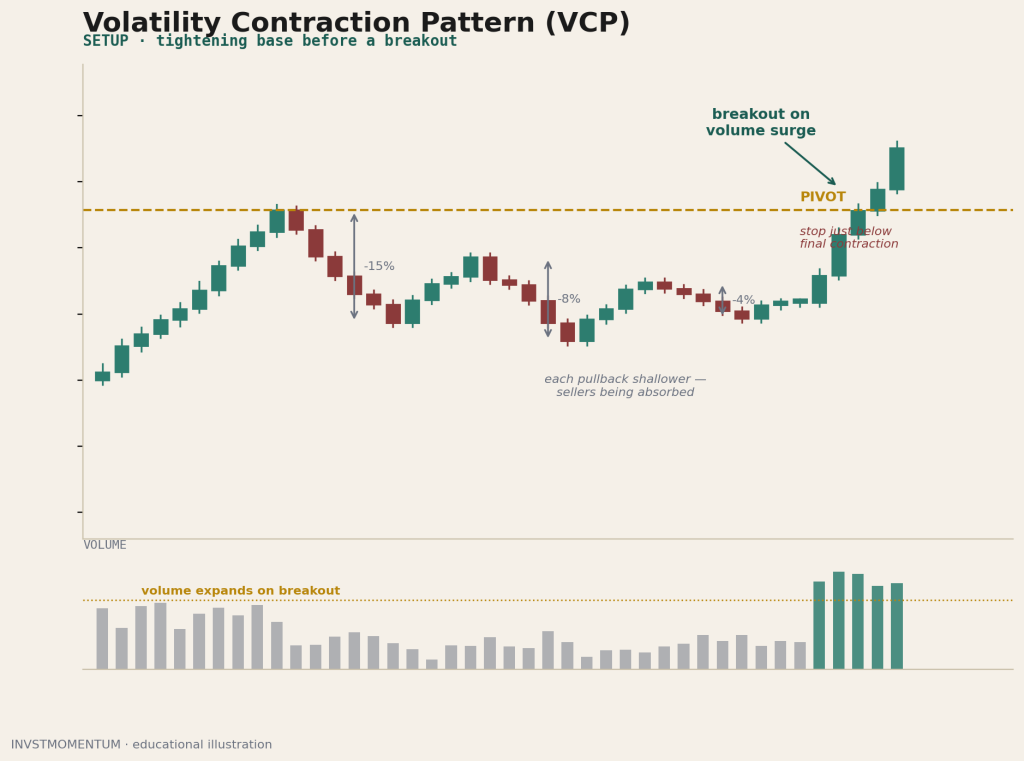
VCP — Volatility Contraction Pattern
Supply gets absorbed in waves: each pullback shallower than the last, volume drying up wave by wave, until price coils just under the pivot — then the smallest new demand moves it violently. The stop sits below the final contraction, which is why good VCPs offer exceptional risk:reward.
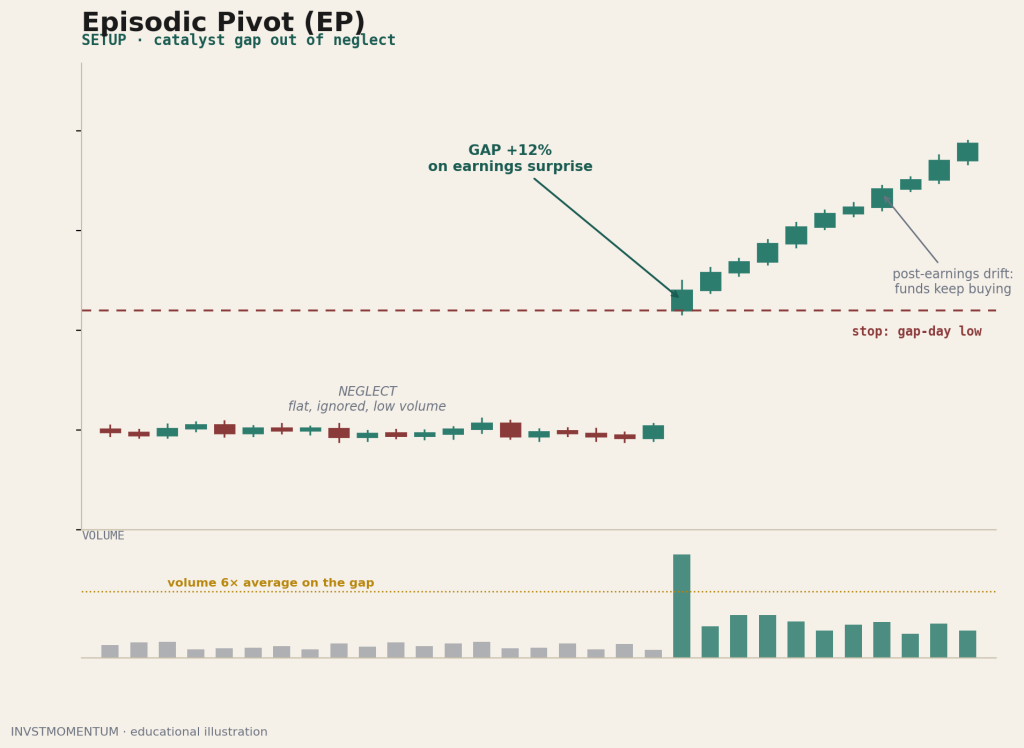
Episodic Pivot — the catalyst gap
A genuine surprise — blowout earnings, a guidance raise — gaps a neglected stock out of its base on institutional volume. Funds can’t build full positions in one day, so real surprises get bought for weeks. The gap-day low is the line in the sand: break it and the thesis is dead.
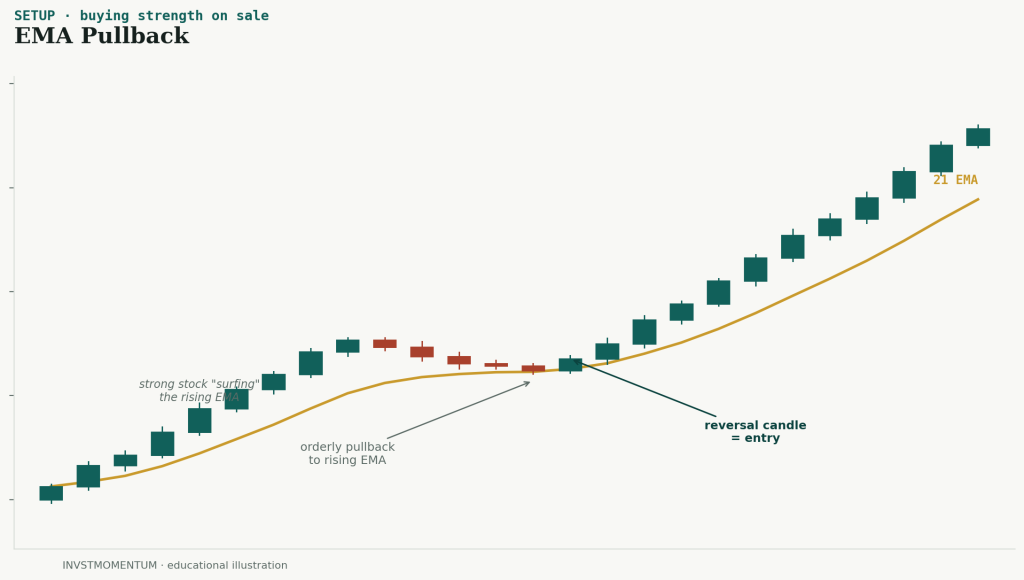
EMA Pullback — buying strength on sale
A strong stock you missed pulls back to its rising 21 EMA on light volume — institutions buying their dip. A reversal candle at the line is the entry; the stop sits below its low. You join the trend at a logical level with defined risk, instead of chasing the high.
Start with Level 1. It costs an email address.
Educational content only. Nothing in these courses or tools is investment advice or a recommendation to buy or sell any security. Trading involves substantial risk of loss.